

The U.S. Cybersecurity and Infrastructure Security Agency (CISA)—the federal body tasked with safeguarding the nation’s critical infrastructure from digital threats—is currently grappling with a self-inflicted security crisis. Following a bombshell report by KrebsOnSecurity, it has been revealed that a CISA contractor inadvertently, yet intentionally, exposed a treasure trove of sensitive agency credentials and AWS GovCloud keys on a public GitHub repository.
The leak has triggered a swift and aggressive response from Congress, with lawmakers demanding accountability for what they characterize as a systemic failure in security culture. As the agency scrambles to rotate compromised keys and contain the fallout, the incident has reignited debates regarding the vulnerability of federal networks and the risks posed by third-party contractors operating without adequate oversight.
The Anatomy of the Breach: A "Scratchpad" of Secrets
The vulnerability centers on a public GitHub profile titled "Private-CISA," created in November 2025. Investigations by security researchers suggest that a CISA contractor with administrative access to the agency’s internal code development platform utilized this public repository as a personal "scratchpad." Instead of following established secure workflows, the individual bypassed GitHub’s built-in protections against credential exposure, pushing plaintext secrets directly into the public domain.
The repository contained a dangerous assortment of sensitive data, including AWS GovCloud keys, internal system passwords, and configuration files. Security experts who audited the repository noted that the file structure and naming conventions—with labels such as "Important AWS Tokens.txt" and "kube-config.txt"—pointed to an individual using the platform for synchronization between professional and personal workstations.
The breach was not merely a passive oversight; it was an active bypass of security controls. Commit logs indicate that the user intentionally disabled GitHub’s secret-scanning protections, which are designed to alert developers when they attempt to commit sensitive API keys or passwords.
Chronology of a Digital Oversight
The timeline of the exposure highlights a troubling gap between the initial breach and the agency’s remediation efforts:
- November 2025: The "Private-CISA" repository is created on GitHub, serving as an unofficial sync point for agency-related data.
- Late April 2026: The repository is populated with its most sensitive and critical secrets, including high-level AWS access tokens and internal configuration data.
- May 18, 2026: KrebsOnSecurity publishes the initial report exposing the repository. The news sends shockwaves through the cybersecurity community, highlighting that a contractor at the nation’s premier cyber agency had exposed federal secrets.
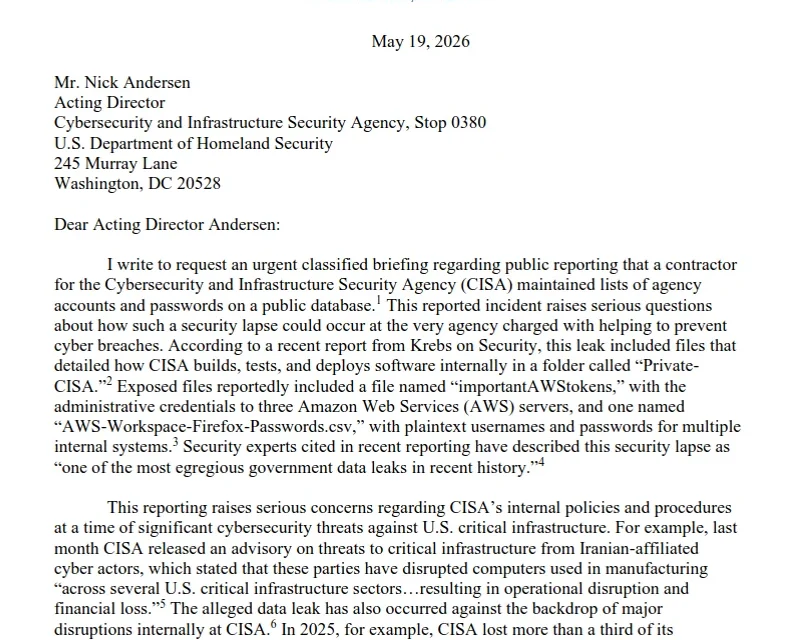
- May 19, 2026: Sen. Maggie Hassan (D-NH) and Rep. Bennie Thompson (D-MS) issue formal letters to CISA’s acting leadership, demanding immediate explanations and proof of remediation.
- May 20, 2026: Dylan Ayrey, founder of Truffle Security, identifies that a critical RSA private key remains active. This key granted full administrative access to the CISA-IT GitHub organization.
- Late May 2026: CISA begins a frantic, ongoing effort to rotate credentials and secure the compromised infrastructure. As of the latest reports, some non-public credentials remain unrotated, leaving the agency in a state of high alert.
Supporting Data: The "Firehose" of Vulnerability
The gravity of the situation was compounded by the nature of how modern cyber adversaries operate. Dylan Ayrey, creator of the open-source secret-discovery tool TruffleHog, explained that public repositories are constantly monitored by automated bots operated by both security researchers and malicious actors.

"We monitor that firehose of data for keys, and we have tools to try to figure out whose they are," Ayrey noted. "We have evidence attackers monitor that firehose as well. Anyone monitoring GitHub events could be sitting on this information."
The specific RSA key identified by Ayrey on May 20 illustrates the catastrophic potential of the leak. Because this key was tied to a GitHub app with full access to the CISA-IT organization, an attacker could have:
- Read proprietary source code: Accessing private repositories to discover further vulnerabilities.
- Hijacked CI/CD pipelines: Injecting malicious code into the software supply chain, which CISA then propagates to other federal systems.
- Modified Administrative Rules: Altering branch protection and webhooks, allowing for persistent, long-term access that would be nearly invisible to standard monitoring tools.
Official Responses and Political Fallout
CISA’s initial response was measured, stating, "There is no indication that any sensitive data was compromised as a result of the incident." However, this boilerplate assurance did little to placate lawmakers.
Sen. Maggie Hassan, in her May 19 letter to Acting Director Nick Andersen, expressed grave concern: "This reporting raises serious concerns regarding CISA’s internal policies and procedures at a time of significant cybersecurity threats against U.S. critical infrastructure."
The political pressure is heightened by the current state of CISA’s workforce. The agency has seen a massive turnover in personnel—losing over a third of its staff due to forced buyouts and early retirements during the recent administrative transition. Rep. Bennie Thompson, joined by Rep. Delia Ramirez, highlighted this in their correspondence, suggesting that the breach is a symptom of a "diminished security culture."
"It’s no secret that our adversaries—like China, Russia, and Iran—seek to gain access to and persistence on federal networks," Thompson wrote. "The files contained in the ‘Private-CISA’ repository provided the information, access, and roadmap to do just that."
In a follow-up statement, CISA claimed it is "actively responding and coordinating with the appropriate parties and vendors to ensure any identified leaked credentials are rotated and rendered invalid."
Implications: The "Human Problem" of Modern Security
The incident raises a fundamental question that plagues modern IT departments: Can technology truly prevent human error?
James Wilson and Adam Boileau of the Risky Business security podcast argued that the CISA breach represents a failure that transcends technical controls. While an organization can enforce policies on company-owned infrastructure, it is nearly impossible to prevent a rogue contractor from creating an external account and uploading sensitive data to a personal, unmanaged cloud environment.
"This is a human problem where you’ve hired a contractor to do this work and they have decided of their own volition to use GitHub to synchronize content from a work machine to a home machine," Boileau noted. "I don’t know what technical controls you could put in place given that this is being done presumably outside of anything CISA managed or even had visibility on."
A Lesson in Vigilance
The CISA leak serves as a cautionary tale for all organizations, public or private. It highlights that the "insider threat" is not always a malicious actor—often, it is a well-meaning employee or contractor attempting to improve their own workflow efficiency without realizing the catastrophic risk they are introducing to the enterprise.
As CISA continues to clean up the mess, the incident will likely lead to stricter federal regulations regarding the use of personal third-party cloud services, potentially forcing agencies to adopt even more restrictive "walled garden" environments for their contractors. For now, the agency remains in a reactive posture, forced to treat its own infrastructure as a potential crime scene while it works to ensure that the "Private-CISA" repository remains the only breach in its perimeter.
The ultimate cost of this exposure—in terms of potential compromises to federal networks and the erosion of public trust—remains to be seen. However, one thing is certain: the agency tasked with defending the nation’s digital borders has learned a painful lesson about the dangers of looking inward at the gaps within its own house.
